Monday, January 4, 2016

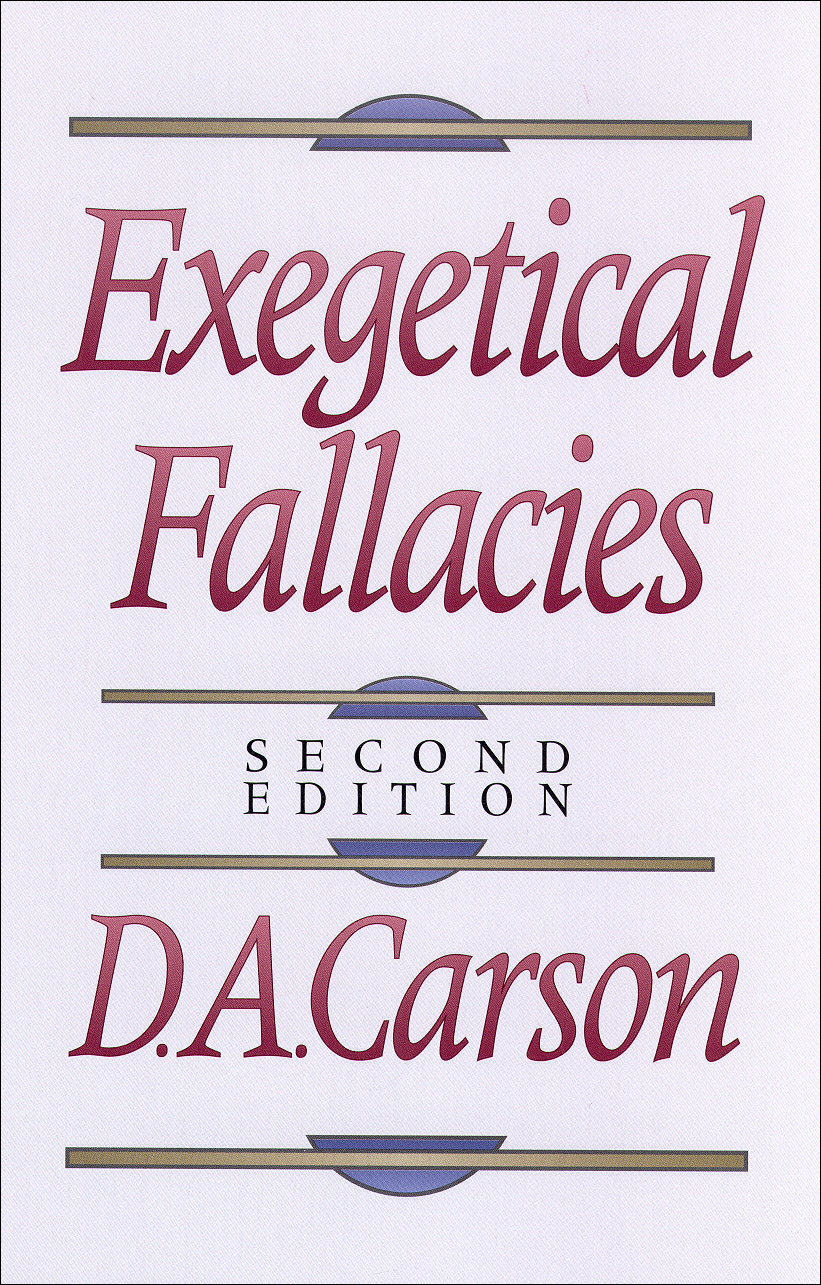
Exegetical Fallacies - Personal Reflection

Introduction
Hermeneutics - the art and science of interpretation - requires faithfulness and hard work of pastors and theologians. Indeed, Christians, who are lay leaders or lay people, also have an equal responsibility to know and study the Word of God. If they are not called to full-time ministry, however, they do not get the same privilege of receiving a robust and theological training under experienced pastors or scholars and to be prepared for ministry as prospective pastors and theologians do. Certainly and specifically, pastors who are shepherding the flock and explaining the Scripture must “rightly [handle] the word of truth” (2 Timothy 2:15 ESV). Pastors get the special privilege of immersing themselves in studying the Word of God in its original language - Greek, Hebrew, and Aramaic. Pastors should study and know the Scripture so that they can explain the text to the congregation. Nonetheless, however, pastors do make mistakes during the preparation of their sermons. They may make mistakes by misinterpreting the main idea of a passage, a word, or reading into the text with presuppositions, which is also called eisegesis. They risk themselves in committing what D.A Carson calls “Exegetical Fallacies”.
In his book, Exegetical Fallacies, D.A Carson is troubled because pastors and theologians are at risk in committing exegetical fallacies without recognizing them. Carson proceeds in listing out various interpretative fallacies, explaining what the fallacies mean, providing examples of such fallacies, and explaining why they are exegetical fallacies. In reading this book, it is beneficial that the readers gain sufficient knowledge in Biblical Greek - its language and its grammar. Carson carefully and logically explains exegetical fallacies with technical terminologies in Biblical Greek, grammar, linguistics, and philosophy. His style in writing the book is academic and scholarly.
I have greatly benefited in reading Exegetical Fallacies. Reading this book was very tough for me because it contained strong vocabulary and terminology that I was not familiar with. I had to wrestle with the logistics of Caron’s arguments. There were a lot of moments while reading where I had to reflect upon my experience in exegeting a passage. In this assignment, I will only identify three specific exegetical fallacies that I may tend to fall into. In identifying them, I will explain what each of the fallacy is, the examples that are given by Carson, my personal reflections upon it, provide examples in my personal experience (if possible), and ways to avoid committing this fallacy. Additionally, I will use the plural noun, “interpreters”, to refer to pastors, theologians, and scholars.

The Aorist Tense
On page 68 of Exegetical Fallacies, Carson begins the discussion of the second category: “Grammatical Fallacies”. In this category, the first of the fallacies is called, “the aorist tense”. Aorist tense refers “to the action itself without specifying whether the action is unique, repeated, ingressive, instantaneous, past, or accomplished.” Carson references Frank Stagg’s writing, “The Abused Aorist”, in order to make a critical argument on how aorist tense should function.
The issue that emerges from interpreters is the idea that aorist tense only has a single function. Carson writes, “competent scholars were deducing from the presence of an aorist verb that the action in question was ‘once for all’ or ‘completed’.” Although aorist tense has been described as the punctiliar tense, nonetheless, grammarians recognize that it is not always used as a specific action point that happened only once in the past.
In Scriptures, sometimes an aorist tense is used as a specific action that happened only once in the past. In the example given on page 68, in 1 Corinthians 5:7, it says, “for Christ our passover lamb was sacrificed”. “Was sacrificed” is the aorist tense for ετυθη (etuthe). Indeed, Christ died once for all at the cross (Hebrews 10 also affirms this).
On the other hand, Stagg provides numerous counterexamples where the aorist tense is not always used as a completed action, but I will list out a few that stood out to me:
“these all died (απεθανον [apethanon]) in faith” (Heb.11:13) - but clearly not all at the same time!
“guard yourselves (φυλαξατε [phylaxate]) from idols” - which clearly does not mean that if we have guarded ourselves once, the danger is over.
“that he might show (ενδειξηται [endeixetai]) in the coming ages the incomparable riches of his grace” (Eph 2:7) - which clearly does not mean God will display his grace just once in all eternity and get it over with.
Upon further reflection, I am deeply amazed at how complex the Biblical Greek language is, especially in dealing with a single tense. As I studied Biblical Greek with a Professor Emeritus at my church, aorist was initially confusing to me. For me to understand it easily, I would assume aorist is simply past tense or an action that was done in the past. Knowing this concept of the aorist tense, would I commit this fallacy? When reading the English translation and carefully interpreting the passages, I would never have imagined that my English Bible would mask a lot of subtle nuances in dealing with the aorist tense. With one of the counterexamples given by Stagg, it is obvious to me that Hebrews 11:13 does not mean the saints in the Old Testament all died at the same time.
I have properly understood the function and the usage of the aorist tense. For sure, I learned that it is not only a “completed” action in the past. In order for me to avoid making an exegetical fallacy, I think reading the entire context of the passage is key to exegeting the passage faithfully.
Improperly Handled Syllogisms
On page 94 of Exegetical Fallacies, Carson advances to the next discussion of the third category: “Logical Fallacies”. In this category, the fourth of the fallacies I want to interact with is called, “Improperly Handled Syllogisms”. A syllogism is a logical argument whereby it applies deducing reasoning that contains a major premise, a minor premise, and a conclusion. For example, the major premise is that A is C; the minor premise is that B is C; therefore, the conclusion is that A = B.
Syllogism needs to be used with extra care. Carelessly using syllogism in biblical exegesis can lead to a sloppy logic argument, which then leads to a logical fallacy. During a conversation with my family members, we discussed getting a new car for my mom. We filtered our options to find the best suitable car for her. Someone used syllogism, unknowingly, to make an attempted rational decision. His major premise was that my mom enjoys watching Korean drama. His minor premise was that Hyundai (an automobile company) is made from Korea. The conclusion, therefore, is that my mom would enjoy driving a Hyundai car. Using syllogism to decide to finance a new car for my mom may not be the wisest strategy. It is an inadequate argument because my mom may enjoy only some parts of Korean culture. Similarly, Caron illustrates another syllogism that contains an erroneous conclusion:
All dogs are animals.
A cat is an animal.
Therefore a cat is a dog.
Caron is not against using a syllogism to make logical arguments. He does caution, however, that interpreters would phrase the premise carefully and properly. He states that “syllogism holds only if A is not identical with B.  But if there are good reasons for thinking that A = B, then [the] argument will not work.”
I reflected upon the example that Caron used, such as Romans 10:9-10. He does not support arguments like these:
Whoever confesses with his mouth and believes in his heart will be saved.
Mary Jo is saved.
Therefore Mary Jo has confessed with her mouth and believed in her heart.
or, better:
Whoever confesses with his mouth and believes in his heart will be saved.
Mary Jo has neither confessed with her mouth nor believed in her heart.
Therefore Mary Jo will not be saved.
I do not often use a syllogism to draw out inferences on a passage. With the passage on Romans 9, I would appreciate it if Carson can draw out more theological implications on Soteriology even though his focus is on proper exegesis. After reading this section, I asked myself some questions: “Is it biblical for a person to receive salvation without confessing Jesus as Lord? Is confessing Jesus as Lord part of the Gospel presentation? Would Christians live in carnality if they do not recognize Jesus as Lord?” These questions indeed bring out the issue of Lordship Salvation, but I digressed. Since Carson was dealing with a logical fallacy, I would need to constantly practice exegesis in order for me to notice myself committing exegetical fallacies. Because this concept is relatively new to me, I would need to further reflect on this section in the future.

Fallacies Of Question-Framing
Finally, on page 105 of Exegetical Fallacies, I am continuing the discussion on the third category: “Logical Fallacies”. In this category, the seventh of the fallacies I want to finish the discussion with “Fallacies Of Question-Framing”. This fallacy deals with the way questioners frame the question whereby “the questioner has imposed his or her understanding of the situation on the person being questioned.”
Carson briefly deals with this section. For example, “when did you stop beating your wife” is an irrelevant question if the situation never happened in reality. The questioner presupposes that the situation actually happened without asking “did you beat your wife before” (I think that’s a better way to frame the question). Additionally, he cautions interpreters to not frame a question where there is a dichotomy and it demands a choice between two answers. For example, was Paul a legalist or an antinomian?
I struggled with framing questions. This particular section helped me to carefully ask the right questions without committing an exegetical fallacy. Whenever I do exegesis, I usually ask myself, “What does this verse mean?” I think framing that question is more open-ended rather than close-ended.

Final Thoughts
I take 2 Timothy 2:15 very seriously, for it says, “Do your best to present yourself to God as one approved, a worker who has no need to be ashamed, rightly handling the word of truth.” Exegetical Fallacies is a book that I would want to revisit and make references. I want to pursue with great diligence to seek God’s approval. This “approval” is not speaking about salvation, but one that has been tested and approved by God. One of the tests is to “rightly handling the word of truth” or the “word of God”. I desire to give my maximum effort to study God’s word completely, accurately, and clearly so that I can communicate His Word to the congregation. Precision and accuracy are required in biblical interpretation because I am handling God’s word. Therefore, I do not need to be ashamed when correctly handle His word. However, I should be ashamed if I mishandle His word. There is an end-time nuance in this verse because of the word “approved by God”. Like interpreters, Timothy will stand before God and give an account of his life. Teaching or preaching is especially dangerous because teachers will be judged with greater strictness (James 3:1). As I am in Immerse being trained for pastoral ministry, I want to be very careful with what I teach because I will also give an account “for every careless word” that I say (Matthew 12:36).

Thursday, May 14, 2015

On The Attributes of God...

The question of describing "who God is" is a critical matter in all areas of biblical teachings and practices. How you understand God can influence your faith. In orthodox Christianity, it is my firm conviction and belief that Scripture reveals God Himself as the Trinity: One God in Three Persons. I am sure that all of the conservative Protestant churches can attest to that. However, the main issue emerges when we try to explain and describe what God is.

It is my great concern that the congregation in the churches do not know their God well enough. As J.I. Packer said in his classical work, Knowing God, "Our aim in studying the Godhead must be to know God himself better. Our concern must be to enlarge our acquaintance, not simply with the doctrine of God's attributes, but with the living God whose attributes they are" (p. 21-22). As Christians know God better, indeed their lives and their minds are being transformed. 


The knowledge of God is ultimately gained by reading and studying the Word of God. The Scriptures attest to that in 2 Timothy 3:16-17, "All Scripture is breathed out by God and profitable for teaching, for reproof, for correction, and for training in righteousness, that the man of God may be complete, equipped for every good work."  


When explaining and describing what God is, I am talking about His attributes: mercy, love, wisdom, knowledge, faithfulness, self-sufficient, righteous and so forth. 


In this generation, there prevails a great theological error surrounding the attributes of God, which is to elevate one of God's attributes over His other attributes. 


Most people would recognize the love of God as His attribute. Indeed, the apostle John said that "God is love" (1 John 4:8, 16). I believe in the love of God. I am also encouraged by the fact that God does love in action. Children in Sunday school would memorize John 3:16, "For God so loved the world, that he gave his only Son, that whoever believes in him should not perish but have eternal life." The Apostle Paul indicates the demonstration of God's love in Romans 5:8. 


The theological error does not consist in the fact that God is love, but when God's love is elevated more than His other attributes. "We believe that God's greatest attribute is love" is an erroneous statement of faith. The New Testament, especially 1 John, speaks about the love of God a lot. Don't make the mistake between emphasis and elevation. When John wrote his first letter, love is indeed the emphasis or one of the themes because that's one of the ways to know if one is a born-again Christian. However, do not equate emphasis to elevation. "...it should caution us not to take any one of these descriptions by itself and isolate it from its immediate context or from the rest of what Scripture says about God. If we did that, we would run the risk of misunderstanding or of having an imbalanced or inadequate picture of who God is. Each description of one of God's attributes must be understood in the light of everything else that Scripture tells us about God. If we fail to remember this, we will inevitably understand God's character wrongly" (Grudem, Wayne. Systematic Theology. p. 159). 1 John does say that God is love, but it is theologically dangerous to narrow our focus of who God is on a single epistle and separate the knowledge of Him from the rest of Scripture. 


Indeed, I admit, the love of God is more appealing than the wrath of God. His loving attribute does affect us emotionally and spiritually. Yet the whole of Scripture does not submit to our emotions, for Scripture is sufficient and authoritative. Calvin warns us about this mindset in his Institutes, "The effect of the expression, therefore, is the same as if it had been said, that he is of infinite majesty, incomprehensible essence, boundless power, and eternal duration. When we thus speak of God, our thoughts must be raised to their highest pitch; we must not ascribe to him any thing of a terrestrial or carnal nature, must not measure him by our little standards, or suppose his will to be like ours". Or another version can be said like this, "lest we dream up anything earthly or physical about him, lest we measure him by our small measure, or conform his will to our emotion" (Calvin, John. Institutes of the Christian Religion. 3.20.40). If God's love becomes more appealing and the greatest attribute against the rest, we have worshiped the wrong God or only part of God. You can end up believing in the god of Rob Bell who wrote Love Wins, becoming a heretic and destroying the message of the Gospel. 


Have you ever sat down and reflected on what God verbally said about Himself? The authors of Scripture do describe His attributes in various places, but what does God say about Himself? Moses penned it down in Leviticus 19:2, "You shall be holy, for I the Lord your God am holy." Whatever happened to teaching and reflecting about God's holiness? Additionally, whatever happened to teaching and reflecting about God's immutability, wisdom, justice, wrath, faithfulness, knowledge, self-sufficiency and so forth?


In conclusion, it is indeed my concern that the congregation in the churches do not know their God very well. Rather, they only know one part of God. 


An (imperfect) illustration that can hopefully drive home my argument. You and your significant other have started dating. Both of you are in the honeymoon phase and love to be with each other because you found that this person is "compatible" with everything you love. Initially, you find that the other person is so kind, nice and loving. As both of you continue to know each other as a couple, you start to know the "bad" side of that person. You may realize that the other person is selfish, gossipy, arrogant and so forth. Perhaps you may contend with that person and still love him or her. After getting married, you start to realize that person is irresponsible, lazy, messy and so forth. Although you may not like his or her bad behaviors, you still love that person as a whole for who he or she is. You cannot just love that person when he or she is nice and loving. To truly love someone is to love that person as a whole even though he or she is not perfect. 


The God of the Bible is perfect and sinless. Scripture has already reveal everything we need to know about God. Though you may not like one of His attributes, God will not change according to your liking - consider His immutability (Malachi 3:6; Numbers 23:19). Though we can continue to grow in the knowledge of God in this life, we cannot fully know God due to our sinfulness and our finite minds. Hence, I agree with the Reformed maxim "the finite cannot contain the infinite".  


To love God is to love Him as a whole being. To know God is to know Him as a whole being. To worship God is to worship Him as a whole being. "We must remember that God's whole being includes all of his attributes: he is entirely loving, entirely merciful, entirely just, and so forth. Every attribute of God that we find in Scripture is true of all of God's being, and we therefore can say that every attribute of God also qualifies every other attribute" (Grudem, Wayne. Systematic Theology. p. 179)


UPDATE (Jan 27, 2016): I was recently informed on the teaching called Open-Theism, where it teaches that God's love is the greatest attribute. Additionally, it teaches that the future is not settled, it is open; therefore, God does not exactly know the future, which denies the meticulous Sovereignty of God and God's omniscience. 


Wednesday, March 25, 2015

"Peace", When There Is No Peace

Once you are in vocational ministry, it does not take too long for you to take into careful consideration of all the teachings that are in the world. These teachings are from "Christians", theologians, pastors, authors, and writers. As a minister, I do read the news from time-to-time. I notice what is happening in the world. At the same time, I also read articles, news, and blog entries written by professing Christians who claim to have high-view of Scripture. High-view of Scripture is a good attitude to have; at the same time, a person with a high-view of Scripture may also have low-literacy of Scripture.

I regret this, but I read some entries from Huffington post by this guy, some guy and the same guy. I know who Mooney is though not personally. Like Rob Bell who questioned the existence of Hell in his book, Love Wins, Mooney makes very bold statements and claims that Jesus did not believe in hell, Jesus did not care about doctrines, and God saving everyone in the end like the story of Jonah. Because of all those posts, there is no need to believe that everyone will go to hell. God's grace and love will prevail in the end. Everybody will be saved. 

On a personal note, I really want to believe what Mooney says. Let's all admit...Hell is not a pleasant word. To some, hell can be a good word since they'll meet their buddies and party there. I really want to believe that in the end everyone will be saved. No one needs to suffer. It does sound very nice. 

Knowing the Word of God to be inspired by God and His Word is inerrant, I cannot believe what Mooney says are absolutely the Word of God. I cannot promote "Peace"; when in the end, there is no peace. I cannot promote "Everyone will go to heaven"; when in the end, not everyone will go to heaven. I cannot promote "No Such Thing As Hell"; when in the end, there will be some who will be "vessels of wrath" (Romans 9:22).  

Thankfully, I am not the first one to see this. Young Jeremiah have experienced it in his time in Jerusalem (Jeremiah 6:14). When Jerusalem was prophesied to be destroyed by Babylon, many false prophets have risen to comfort everyone with lies. They claim to have come from God, when God never called them (Jeremiah 23). 

Let's fast-forward to Jesus' time. Jesus gave his disciples a prophetic event that will happen in the future. The reality of this future event implies that "many false prophets will arise and lead many astray." (Matthew 24:11) Jesus calls us to be ready because the "Son of Man is coming at an hour you do not expect." (Matthew 24:44) God's final judgement will come through 2nd coming of Jesus Christ. Similar to what happened to King Zedekiah, God's judgement came on Jerusalem through Babylon. 

Let's fast-forward to the time of Paul's last letter to Young Timothy. False teachers have already crept inside the church, and Timothy had to deal with them. Timothy was timid, weak, and constantly had ailment. Paul does not sympathize with him, but gives him strength and exhortation to press on. Paul said, "preach the word; be ready in season and out of season; reprove, rebuke, and exhort, with complete patience and teaching. For the time is coming when people will not endure sound teaching, but having itching ears they will accumulate for themselves teachers to suit their own passions, and will turn away from listening to the truth and wander off into myths. (2 Timothy 4:2-4)

I really hope Mooney also read the book of Nahum because Nahum prophesied God's judgement on Nineveh a generation after Jonah.

Thursday, March 19, 2015

The Nature Of A Spiritual Infant


A baby is completely dependent upon the care and provider of the parents. A baby cries for various reasons, and the parents have to decipher what the baby wants. A baby hungers and thirsts, so the parents feed their baby with milk. So, we can agree that a baby naturally needs someone in order to survive.

The analogy of a baby is a good transition to the topic that I want to speak about. A Christian is described in various images in Scripture: a sheep, a member of the body of Christ, a part of the temple of God, a bride of Christ, a salt, a light, an infant and so forth.

A Christian is an infant. Thankfully, God knows fully well what a Christian needs. Peter said, "Like newborn infants, long for the pure spiritual milk, that by it you may grow up into salvation—if indeed you have tasted that the Lord is good." (1 Peter 2:2-3)

Christians are newborn infants because they have been spiritually born-again by the Holy Spirit (John 3). As newborn infants, Christians are no longer "by nature children of wrath" (Ephesians 2:3); Christians are a "new creation" (2 Corinthians 5:19). Because Christians are born-again, because Christians are infants, because Christians are new creation, Christians ought to naturally desire milk - spiritual food - Scripture or the Bible. 

It is the nature of Christians to be dependent on God. It is the nature of Christians to progressively know God. It is the nature of Christians to progressively desire to know God. It is the nature of Christians to progressively and naturally hunger and thirst for God. Jesus said, "Blessed are those who hunger and thirst for righteousness, for they shall be satisfied." (Matthew 5:6) The Beatitudes are the characters that describe what a Christian looks like. Any Christians who are self-reliant and independent would lead him/her to spiritual despair, amnesia and vulnerability.  

Singing hymns are generally my preferable style of worship. Not all hymns, however, equally have good theology. In "Guide Me O Thou Great Jehovah", I invite you to read these two lines:
Bread Of Heaven, Bread Of Heaven 
Feed Me Till I Want No More
In context of this hymn, when the Israelite was in the wilderness, they need manna or food. Manna were breads that fell from heaven. Physical nourishment is important, and there is a suggested theological implication that physical fulfillment is temporal. 

After doing much research on this hymn, this lyric was probably not the original, but was probably edited. Regardless of what the original was, "feed me till I want no more" does not sound correct. It is implying or suggesting that spiritual nourishment is temporary rather than an ongoing desire for that nourishment. 

Think about it, a baby naturally needs physical nourishment. For Christians, they naturally (or supernaturally) also need spiritual nourishment from the Word of God. Without the knowledge and practice of the Word of God, Christians cannot spiritually grow into maturity (2 Timothy 3:16-17). 

Meditate on this response from a "Christian": "Thank you God for the Bible. I finished reading it and I want it (or God) no more." 

A proper response would be this: "Thank you God for feeding me with your Word, and I desire more." And off you go to your other activities as you look forward to your next devotion because you want more of God's Word and Himself. 

As I was saying about the lyric, there was a change. Whether if you have been a Christian for a long time or if you've recently became a Christian, I hope that we would always have the attitude of being an infant that longs for God and be close with Him. So here's the alternate lyric:
Bread Of Heaven, Bread Of Heaven 
Feed Me Now And Evermore

Monday, February 16, 2015

Knowing Dead Guys


For those who are in my church, you may have heard me quote a sentence during sermons, seminars or Sunday school lessons, and I would say, "The person who said this quote is a dead guy in the [so and so] century."

Although the selected sentences may sound archaic - or should I say "old"? - they contain more theological richness than, I think, John Piper, John MacArthur, Mark Jones and so forth could pen down.

Dead guys such as John Bunyan, who draws out words or sentences, using allegory, to tell a beautiful story, yet deep theology, in Pilgrim's Progress.

Dead guys such as John Calvin, who was a genius exegete.

Dead guys such as Charles Spurgeon, who was known as the prince of preacher.

I found knowing dead guys have greatly reinforced my walk with Christ and my understanding of Scripture. Their works are influential and edifying to the souls. Their works have caused them to spill their own blood. Their works are worth attentive studying and reading (although I admit that reading Geerhardus Vos' Biblical Theology has put me to sleep countless times).

I encourage you to get to know some of these dead guys. Indeed, be updated with modern issues that they may not have dealt with.

Personally, I don't expect myself to know all of them at great length, but I have chosen to study two or three dead guys' work.

John Owen - known as the greatest theologian in history.

Charles Spurgeon - known as the prince of preacher.

James Montgomery Boice - known as the defender of Biblical Inerrancy.

Thursday, October 30, 2014

Reformation Day


On Friday, many people, especially children, will dress up and collecting candies from door-to-door. People look like the characters they see in the movies or TV shows. It can be scary or entertaining. 

For Christians, however, October 31st is a sweeter treat than Halloween candy. Christians do have a "day" to celebrate. It is a significant day that we can never forget and take for granted. October 31st is indeed Reformation Day. This day commemorates an event that struck Wittenburg (Germany) with a hammer bang on the church door by a man named Martin Luther

Luther confronted the issues that the Roman Catholic Church was doing for the lay people who had no access to the Bible. The Catholic church was promoting this false teaching called indulgence where it basically teaches that in order to be saved, you have to pay your way to heaven. Luther opposed that idea, the Catholic church and the Pope. Indeed, this confrontation and opposition got him into a lot of trouble in the Catholic church. Luther was soon tried by the church and had to recant of his teaching. During the trial, Luther's response shocked the crowd, "I cannot and will not recant anything, for to go against conscience is neither right nor safe. Here I stand, I can do no other, so help me God. Amen."

Martin Luther's legacy has lived on for 500 years. Luther is one of the most significant figures that God raised up in the early 16th century - October 31st, 1517. Luther nailed his 95 thesis on the church of Wittenburg for the purpose of restoring the missing doctrine called the Doctrine Of Justification By Faith, and confronting the Catholic church. The Catholic church was teaching that we obtain salvation by merit. Luther's rediscovery of the forgotten truth lead to what it was historically called the Reformation or the Protestant Reformation. Luther rediscovered from Scripture that "salvation is by grace alone through faith alone, and good works result from our faith, they are not added to it as the grounds for our right standing in the Lord’s eyes (Eph. 2:8-10). Justification, God’s declaration that we are not guilty, forgiven of sin, and righteous in His sight comes because through our faith alone the Father imputes, or reckons to our account, the perfect righteousness of Christ (2 Cor. 5:21)." (Link
You can read more about Reformation Day by typing this event on the Google Search Engine.
In our western society and the church, this historical event has been forgotten. Christians attend church without understanding the history of how the church got here. Christians, we need to understand why we believe what we believe and teach what we teach. By doing so, we will know what we believe, why we believe it, how to live it, and how to share it

Did you know that because of Reformation Day, we have our own translation of the Bible? Let us continue to not take our faith for granted, but to equip ourselves with Biblical Truth and live out that truth daily.

Thursday, October 16, 2014

Reflections


After six weeks of being away from ministry, Mark Driscoll made his verdict on Wednesday by resigning as a Preaching & Vision Pastor of Mars Hill Church. Simply by typing "Mark Driscoll" on the Google Search Engine, you will find many news pertaining to this story. 

I am personally sad yet not surprised. According to the letter of resignation, Driscoll says, “today, also by God’s grace, and with the full support of my wife Grace, I resign my position as pastor and elder of Mars Hill. I do so with profound sadness, but also with complete peace.” He also noted that his situation is not safe or healthy for his family. 

I was first exposed to Mark Driscoll's teaching as a young new Christian. I think the first message that I heard from him was either the "Religion Saves" series or "1 + 2 Peter" series or one of the Easter messages. He's very influential in his style of preaching. He's boldness to talk about controversial issues sparked many interests to the "Young, Restless and Reformed". I love Driscoll. I love his enthusiasm. I love his toughness on men. I am sure that many Christians were influenced by him. 

Without getting too deep into the discussion of what happened for the past two years with his ministry, this entry is not an attack on his reputation. I am 100% sure that there's already enough of that going on in the internet. This entry is simply reflections on what I've learned and observed from the ministry of a mega-church pastor.
==========================================
#1: Fruit is important
==========================================
Someone told me, "Driscoll may be going through a lot of trouble, but at least his messages have transformed many people's lives. He has solid teaching and solid theology." 

There is truth to that statement. We need to, however, remember what Paul said to Timothy, "Keep a close watch on yourself and on the teaching. Persist in this, for by so doing you will save both yourself and your hearers." (1 Timothy 4:16) To keep a close watch on yourself means to watch out in how you live your life. John MacArthur said, "the priorities of a godly leader are summed up in his personal holiness and public teaching." We already know on the news that Driscoll's behavior towards his colleagues is abusive. We already know the controversies that he's involved in. Though his teachings are Biblical, the teachings also need to reflect his life.

We all need this. We don't just need solid knowledge and being able to teach. Teaching is not the means to the end of a leader. All of us need to pay a closer attention to how we live our lives. Again, John MacArthur states this, "by careful attention to his own godly life and faithful preaching of the word, Timothy would continue to be the human instrument God used to bring the gospel and to save some who heard him. Though salvation is God’s work, it is his pleasure to do it through human instruments."

My pastor said that we need to work on the fruit of the Spirit. Fruit of the Spirit is eternal while Spiritual Gift is temporary. Fruit of what a Christian is while gift is what a Christian does. Gift can be abused because they can be used to manipulate or exert power or control in personal and/or relationships. 

Question for all of us: Do we see the fruit of the Spirit in our lives? How is the fruit being evident in our lives and in the lives of others? Do we live out what we teach/preach?
==========================================
#2: Bad Reputation Is Worse Than No Popularity
==========================================I don't know how to entitle this one, but you may understand my point. 

I used like fame. I used to like people to recognize me and my works. I dreamed of one day to be a "celebrity pastor". However, I have repented of all those ideas and my pride. 

"A good name is to be chosen rather than great riches, and favor is better than silver or gold." (Proverbs 22:1) I highly suggest that all of us hold a good reputation in our own surroundings. May we receive favor from the people we see. Cheating, lying, deceiving, manipulating and abusing for one's own gain is the way of a fool.

I would rather stay low and be recognized by the people in my own church, and that I get to know the flock that I shepherd. There is no doubt that "elders who rule" should be "considered worthy of double honor, especially those who labor in preaching and teaching." (1 Timothy 5:17) We need to respect and thank the elders who look after us and teach us the word of God.

It would be an honor, though, to teach alongside with John MacArthur, John Piper, DA Carson, Tim Keller, and other men with good name. Of course, they have their own critics, but they do hold to the qualifications of an elder. (1 Timothy 3) 

I am called to fulfill my ministry (2 Timothy 4:5), and not be like someone I am not. I don't need to be popular. I don't need to be a celebrity. I want to be faithful with what God has given me.

Question: What kind of name are we making for ourselves? Do we find favor in the eyes the people we work with or go to school with? If someone were to describe you, what would they say about you?
==========================================
Conclusion
==========================================
I think two reflections on my part are good enough. I think that there lots to learn in our own ministry. 

Let us not stop here. As Mars Hill Church and Driscoll are going through a difficult season, it is important that we uphold them in prayer. As "cliche" as this verse is, it still rings solid truth for those who are being conformed into the image of Christ: "And we know that for those who love God all things work together for good, for those who are called according to his purpose." (Romans 8:28)

Friday, September 19, 2014

iPhone 6/6+ and the Human Heart


Last night, my mom asked me to check out the line-up for the release of the new iPhone 6/6+ at Oakridge Centre. A couple of my buddies and I went to Oakridge and saw a massive line-up at 8:30PM. 

In comparison to iPhone 6 and Boxing Day (or Black Friday), you only get the regular price of an iPhone 6, and you do not get any discount for it. I keep pondering, "Why do people line up for a phone that does not help them save money?" It is possible that iPhone 6 is totally a new gadget that people want to get their hands on (no duh). IPhone 6 is a new trend. Some people enjoy being part of the trend or something viral, such as the Ice Bucket Challenge. 

Now, in terms of lining up for an iPhone 6...no comment. (LINKI don't understand everything about people's motivation (although my mom wanted to buy it and sell it in Hong Kong in order to earn profit), but I do know something about the nature of the human heart.

We all desire something or someone to satisfy our inner longing or fulfillment. But why? There are philosophical or scientific answers to these questions, but let's set our focus on what God says to us. 

"He has made everything beautiful in its time. Also, he has put eternity into man's heart, yet so that he cannot find out what God has done from the beginning to the end." (Ecclesiastes 3:11) The author realizes that both his desire to understand all of life, as well as the limitations on his ability to do so, have been ordained by God. We are all wired to understand life, and even have certain desires to fulfill our longings. The reason why these trendy things won't last is because they satisfy us temporarily; they do not satisfy us forever. Within a certain time, we are already seeking out something else to satisfy us. (two months later, people are already waiting for the iPhone 6S)

We are living in a fallen world. A world full of problems. A world full of lust. A world full of sin. A world full of idolatry. The nature of the human heart is that we are sinners. 

Lining up for an iPhone 6, or Boxing Day, or Black Friday, is perhaps to be a day full of idolatry. Believe it or not, we are all worshipers of something or someone. "They exchanged the truth about God for a lie and worshiped and served the creature rather than the Creator." (Romans 1:25)

In order for our hearts to be satisfied, we need to seek out the one who created us. Saint Augustine said, "Our heart is restless, until it rest in Thee." Jesus promises us this, "The thief comes only to steal and kill and destroy. I came that they may have life and have it abundantly. (John 10:10)


I confess...I'll probably line up for the Nexus 6 (Nexus X). If you ever need someone to line up for you, then give me a call. I only charges $20/hour. 

Wednesday, August 13, 2014

Renewing Our Desire To Know God's Word

===========================================
Introduction
===========================================
I want to follow up with another entry from my last post, "Are Christians Done With The Bible?"

The statistics given by the Canadian Bible Engagement Study are astonishing, showing that most Canadian Christians never read the Bible. So, the natural question that follows is: not reading the Bible, does it make a Christian less spiritually mature? Am I adding more rules by insisting on the importance of reading the Bible - being legalistic - over this issue? 

I am certainly not being legalistic over this issue, but rather, it is a pastoral concern for God's people. The Bible speaks about growing spiritually through knowing God's Word (1 Peter 1:23-2:3). Indeed, Christians do need to read the Bible in order to grow into a deep maturity in our walk with God - of course, we need to integrate other ways of growing spiritually as well, such as prayer, fellowship, and evangelism. By not reading and understanding the Bible and, thus not maturing in our faith in God, we will head into wrong directions, we can suffer grave consequences, and we will have a hard time discerning what is good and evil (Hebrews 5:11-6:2). When a false teacher comes to teach at your church, are you ready to discern if he/she is faithfully preaching God's Word? As Christians, it is vitally important that we are rooted in God's Word.
===========================================
Reasons and Responses
===========================================
Tommy, what you said is true and I know I need to read the Bible, but I __________. (fill in the blank)

I have personally heard many reasons (excuses) from Christians for not reading the Bible, and I believe Satan is indeed crafty enough to put some of these deceptive thoughts into the mind of the Christians. There are legitimate reasons for not reading the Bible - if you are blind, or if you suffer from a mental disorder...  if you completely have no access to the Bible in a language that you understand. We pray and hope that somehow God's Word would reach them. But let's say you are not blind and do not have any mental disorder or diseases or whatsoever, you technically do not have many excuses to make. In Canada, we have Bibles everywhere - in church, bookstores, in our apps. We have the greatest privilege to hold God's Word at the palm of our hands! Many persecuted Christians in third world countries LONG to hold the Bible and own one, but we Canadians have taken it for granted. 

Reason #1: I am too tired and busy.
As Jesus said in the Garden of Gesthename, "The spirit is willing, but the flesh is weak." However, Jesus also said, "Come to me, all who labor and are heavy laden, and I will give you rest. Take my yoke upon you, and learn from me, for I am gentle and lowly in heart, and you will find rest for your souls. For my yoke is easy, and my burden is light.” (Matthew 11:28-30) Does this sound promising? That Jesus would give rest for our souls when we learn from Him? If you are feeling tired and busy, Jesus invites you to come to Him. 

Reason #2: I need to feel like reading the Bible first.
When an enemy attacks you during war, will you say, "Oh, I need to feel like picking up my sword/gun first before I go and fight?" You would be dead by then. Our spiritual enemies, Satan and his demons, are constantly attacking us. They will not wait for us to feel like fighting back. Remember, this is a spiritual warfare (Ephesians 6:10-18). We have the need to equip ourselves with the armor of God as opposed to us needing to FEEL like equipping ourselves with the armor of God - this is especially true for the Sword of the Spirit, which is the Word of God.

Reason #3: I can hear the Spirit speak to me so I don't really need the Bible.
"Beloved, do not believe every spirit, but test the spirits to see whether they are from God, for many false prophets have gone out into the world." (1 John 4:1) How do you know if what you hear is the Holy Spirit? You need to test the Spirit. How do you test the Spirit? We need to compare what we hear to God's Word. The Bible holds the highest authority over against whatever we may hear or sense in our thoughts. That's not to say God doesn't speak to us anymore, but if we do hear a voice, and think that it is from God, we need to be spiritually discerning.

Reason #4: I can't understand the Bible.
There are parts in the Bible that are not easy to understand. Peter acknowledges that some of Paul's teachings "are hard to understand, which the ignorant and unstable twist to their own destruction, as they do the other Scriptures." (2 Peter 3:16) However, if you are a Christian filled with the Holy Spirit, you have the spiritual capacity to understand the things of God (Psalm 119:18), as opposed to those who are not Christians. (1 Corinthians 2:14-16) The Holy Spirit illuminates truth to His people, and we need to pray and ask God for help in understanding His Word (2 Timothy 2:7). This is a call for humility.

UPDATE: You can always get a good study Bible that provides commentaries. I highly recommend the ESV Study Bible. 
 
Reason #5: The Bible is just too boring.
John Piper said, "The Bible can NEVER be boring...Avatar is boring!" If that's your attitude towards the Bible, then you need to go back to the basics, which is understanding the Gospel, because this is the issue at heart. When you understand the Gospel, and how the entire Bible points toward Jesus, my prayer and hope is that you will have a profound and renewed desire to know His Word. "How sweet are your words to my taste, sweeter than honey to my mouth!" (Psalm 119:103)
===========================================
Conclusion
===========================================
Okay Tommy, no more excuses for me! I'm going to read the Bible right now!

Before we do that, let's examine ourselves first. We need to confess our sins and repent of them, which means we need to have our minds renewed. We need to come and meditate on the beauty of salvation in Jesus Christ. Jesus asks us, "Do you love me?"

Do we love God? If we love God, then we would want to obey Him. How can we KNOW how to obey Him? God has given us His Word - the Bible - to know Him and to obey Him. We all need a renewed desire to know God's Word. In the entire meta-narrative of the Bible, God has given us the two greatest commandments: Love God and Love Others. God has also called His people to keep His Word because of His love and redemptive work in our lives; from the time of Exodus until now. 

I'm not saying we have to be perfect, but what I am saying is that we be intentional and committed to reading the Bible no matter where we are and what circumstances we are in.

Monday, August 11, 2014

Are Canadians Done With The Bible?


Canadian Bible Engagement Study (CBES) drew a conclusion that the "majority of Canadians, including those who identify themselves as Christians, read the Bible either seldom or never."

As of 2013, CBES conducted an extensive study and research on Canadians, including professing Christians, for "Bible Reading Frequency". I quote, "About one in seven Canadian Christians, or 14%, read the Bible at least once a week. The majority of Canadians, including those who identify themselves as Christians, read the Bible either seldom or never." But what does this mean? 4/5 Canadian Christians report that they read the Bible seldom or never...and here is the rest of the report for "Bible Reading Frequency" in Canada.

5% Read The Bible Daily.
4% Read The Bible A Few Times A Week.
2% Read The Bible Once A Week.
3% Read The Bible Once or Twice A Month.
7% Read The Bible A Few Times A Year.
25% Seldom Read The Bible. 
55% Never Read The Bible. 

As astonishing as this sounds, this is true. About 75% Canadians who profess to be Christians report that they seldom or never read the Bible. Whether the statistics are entirely accurate or not, accuracy is not the real issue. The real issue lies deep down at the core of our personhood - our heart. Do we really love God and what He has to say to us? 

If CBES were to conduct a research at your local church, where would you land in the statistics? This is not done for the purpose of guilt-tripping Christians, but this is epidemic (no hyperbole) and requires a call to reflect on our faith. (click HERE to read more)

Here's the big idea for this entry: MOST CANADIAN CHRISTIANS NEVER READ THE BIBLE.

Where do we go from there? How should I answer the question from the title? It is a call for me to pray for my brothers and sisters in Christ. I need to pray for myself, my pastors, my leaders in Oakridge Baptist Church. I invite you to pray with me as well. 

We may not be perfect, but I pray that we would have the same attitude towards studying the Bible as the Psalmist in Psalm 119, where he shows a vigorous love and passion for God's Word - His inerrant word, His authoritative word, His inspired word, and His sufficient word.